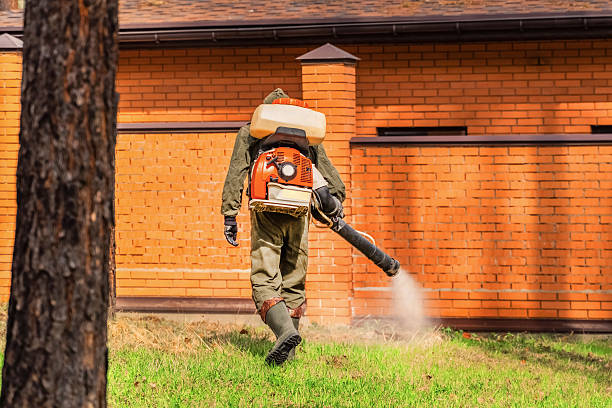
When drywood termites or stored-product pests are distributed throughout a structure, whole-building fumigation reaches what spot treatment can't. Fumigation is a significant undertaking, which is exactly why we walk you through every regulatory requirement before you commit to a tenting date.


Structural fumigation requires specialized state licensing beyond standard pest control certification — our applicators hold it.
Fumigation scheduling accounts for the full vacate-and-return window, coordinated with your timeline as closely as possible.
You'll receive a full written quote covering tenting, fumigant, and clearance testing — no hidden add-ons after scheduling.
Our equipment includes structural tenting systems and continuous gas monitors required for safe, code-compliant fumigation. Beyond the treatment itself, we can provide the documentation many insurance policies require to process a related claim.
Full tenting treatment for drywood termite colonies distributed throughout wall voids and framing, not accessible to spot treatment.
We treat stored-product pest infestations that have spread beyond what sealing and trapping can reasonably address.
Proper preparation before tenting is critical for safety and effectiveness; we provide a clear prep checklist ahead of the date.
The fumigation itself is performed under strict licensed protocol, with continuous monitoring throughout the tenting period.
We don't clear a property for re-entry until gas testing confirms fumigant levels are fully within safe limits.
A follow-up visit confirms elimination and addresses any remaining conducive conditions once you've moved back in. Every fumigation crew also carries backup monitoring equipment, since redundant gas readings are part of doing this safely.

Describe what's been found and where — full fumigation is reserved for infestations spot treatment genuinely can't reach.
We assess the property firsthand before recommending fumigation, since it's a bigger undertaking than routine treatment.
We provide a full written plan covering prep requirements, tenting date, vacate period, and clearance testing timeline.
After tenting and clearance testing, we confirm the structure is safe for re-entry and schedule a post-treatment follow-up.
Drywood termites had spread through multiple rooms — spot treatment wouldn't have cut it. Tenting process was well-organized start to finish.
They coordinated the whole timeline around our hotel stay so we knew exactly when to leave and return.
Warehouse had a stored-product pest problem that had gotten out of hand. Fumigation and clearance testing got us back operating fast.
Appreciated the detailed prep checklist beforehand — nothing was left to guesswork about what needed to be removed.
Historic home with extensive drywood termite galleries throughout the attic framing. Fumigation was the only realistic option and it was handled professionally start to finish.

Coverage includes Dry Ridge and surrounding Dry Ridge, OH communities, with fumigation crews equipped for both homes and larger commercial structures. Multi-family and commercial structures in Dry Ridge sometimes require phased tenting schedules, which we coordinate directly with property management. Before scheduling, we check whether your neighborhood or building has specific tenting notification requirements, so there are no surprises with neighbors or an HOA.

Regular treatment addresses localized activity; fumigation is reserved for infestations spread too widely through the structure for spot treatment to reach.
Typically a few days, depending on structure size and fumigant clearance requirements — we'll give you exact dates during scheduling.
Food, medications, and certain plants generally need to be removed or specially bagged — we provide a complete prep checklist ahead of time.
Structural fumigation is a well-established, code-regulated process when performed by licensed applicators.
We use gas monitoring equipment to confirm safe levels before certifying the structure for re-entry — no guessing involved.
Fumigation eliminates existing infestation; we also flag conducive conditions afterward to help reduce the odds of reinfestation. It also helps to schedule any planned pest treatment for neighboring structures around the same window, since shared walls can otherwise reintroduce activity.
A licensed inspection will tell you honestly whether fumigation is actually necessary for your situation.
Call +1-844-564-2570